
EMPIRE STATE BUILDING HISTORY
About Empire State Building
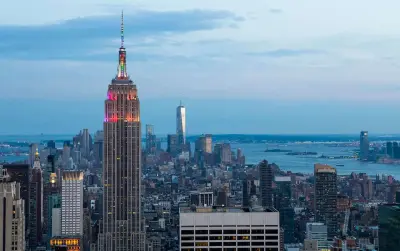
The Empire State Building, an iconic Art Deco skyscraper with a steel frame, was designed by Shreve, Lamb & Harmon and built between 1930 and 1931. Named after New York’s nickname, ‘The Empire State’, it stands at 1,454 feet (443.2 meters) tall, including its antenna, making it the world’s tallest building at the time. Located in Midtown Manhattan at 350 Fifth Avenue, at the corner of West 34th Street and Fifth Avenue, its construction cost was $40.9 million. The building was listed on the New York Register of Historic Places in 1981 and designated a national landmark in 1986.
Upon its completion, it transformed New York City’s skyline and symbolized architectural and economic ambition in the early 20th century. It held the title of the world’s tallest building for nearly 40 years until the construction of the World Trade Center in 1970.

From Waldorf Astoria to the Empire State Building
The site of the Empire State Building was initially owned by John Jacob Astor in the 1820s. In 1893, his grandson, William Waldorf Astor, opened the Waldorf Hotel, and in 1897, his cousin, John Jacob Astor IV, opened the Astoria Hotel. Together, they formed the Waldorf-Astoria, then the world’s largest hotel with 1,300 rooms. After manager George Boldt died in 1918, Thomas Coleman du Pont bought the lease.
By the 1920s, the hotel was considered outdated, and New York’s social scene had moved uptown. The Astor family then built a new hotel on Park Avenue and sold the Fifth Avenue real estate to the Bethlehem Engineering Corporation in 1928. The Waldorf-Astoria closed on May 3, 1929.

First plans
Bethlehem Engineering Corporation had planned a 25-story office building on the Waldorf-Astoria site but couldn’t secure funding. The land was sold to Empire State Inc., a group of investors led by John Jakob Raskob, a key executive at General Motors, Coleman du Pont, Pierre du Pont, Louis G. Kaufman, and Ellis P. Earle. Alfred E. Smith, the former governor of New York and presidential candidate, was named the company’s head. They acquired nearby land to create a 2-acre site and announced plans for an 80-story skyscraper in 1929, which would be taller than any other building at the time.
Architect William F. Lamb, inspired by earlier projects like the Reynolds Building and the Daily News Building, designed the Empire State Building. Following the 1916 Zoning Act, the design included setbacks, giving it a distinctive slim, pencil-like shape. With a $50 million budget and a strict 18-month timeline, construction began even as designs were still being finalized.

Race to design the tallest building
The design of the Empire State Building evolved from 50 to 80 stories to ensure it would become the tallest building. Its location was ideal for transit access and offered more than 2 million square feet of office space. The construction was in competition with 40 Wall Street and the Chrysler Building for the title of the tallest building. After the Chrysler Building added a steel spire, Empire State Inc. responded by adding five floors, a 200-foot crown, and a 222-foot mooring mast, bringing its total height to 1,250 feet and surpassing the Chrysler Building. The final design underwent 15 revisions to meet a fixed budget, incorporated a limestone exterior, and ensured completion by May 1, 1931.
The rapid rise of the Empire State Building
The Empire State Building was built by the Starrett Brothers and Eken, funded by John Jakob Raskob and Pierre du Pont, with engineering by Homer G. Balcom. Demolition of the old Waldorf-Astoria Hotel began at the end of 1929, and construction continued despite the stock market crash. The building progressed rapidly, rising at an impressive rate of 4.5 floors each week. The main structure was completed in September 1930, just 23 weeks after starting, using materials from all over the U.S. and Europe. Once the mainframe was finished, interior work began, and the mooring mast was completed by November 21. The exterior was largely completed by mid-November, and Otis Elevator installed 64 fast elevators, the largest order at that time. The project was a great example of innovative planning, efficiency, and determination during challenging times.

The tallest building in the world in 1931
The building was structurally completed on April 11, 1931, twelve days ahead of schedule. At its peak, the construction involved over 3,500 workers, mostly immigrants and Mohawk ironworkers. Officially, five workers died during the construction, though some reports claim higher numbers. The total cost was $40.9 million, coming in under budget.
The Empire State Building, at 1,250 feet (381 meters), was the first to exceed 100 floors and surpassed the Chrysler Building as the tallest building in the world, ending New York City’s skyscraper rivalry. It officially opened on May 1, 1931, after 1 year and 45 days of construction. President Herbert Hoover remotely activated the lights from Washington, D.C., marking its grand opening. Despite the publicity, its opening was heavily affected by the Great Depression in the United States, leaving much of the office space unoccupied.
Why wait? Book our best-selling Empire State Building Tickets now!

Free cancellation
Empire State Building 86th Floor (Main Deck) Ticket
Enjoy panoramic views of New York City from the main deck of the Empire State Building! Take the elevator, see the Statue of Liberty, Central Park, and six states, and learn from the helpful audio guide and the exhibitions. You can add skip-the-line access and 102nd-floor access for the ultimate experience!

Skip-the-line
Empire State Building 102nd Floor (Top Floor) Ticket
Skip the lines and head straight to the 102nd floor of New York City's most iconic landmark with an express ticket. Take in stunning views of New York City from the observation deck, spotting landmarks like the Statue of Liberty and Central Park. Inside, explore the building’s rich history through interactive exhibits about its construction, Art Deco design, and role in New York’s culture.

Early years
The Empire State Building quickly gained fame as a top tourist destination and became an iconic symbol of New York City. In 1931, it received the Fifth Avenue Association’s Gold Medal for architectural excellence. Visitors from around the globe paid 10 cents to use the telescopes and enjoy views of the city. In 1933, the film King Kong confirmed the building’s status as a cultural and cinematic icon. This marked the beginning of the building’s legendary presence in pop culture and frequent appearances on the silver screen.
Tenants and tourists
When the Empire State Building opened during the Great Depression, much of its office space remained empty, earning it nicknames like the ‘Empty State Building.’ Only 23% of the space was rented in its first year, with early tenants including banks, clothing companies, and NBC, which leased the 85th floor. Many upper floors went unused, and the building lost $1 million annually by 1935.
However, the observation deck became a major tourist attraction, attracting one million visitors in 1931 and generating $2 million in revenue. By 1944, five million people had visited, making the building a symbol of New York despite its early struggles.

The financial success
Fifteen years after its opening, the Empire State Building housed major organizations and 15,000 employees, becoming one of the world’s most profitable and iconic landmarks. By the 1940s, the Empire State Building was 98% occupied, and started making a profit in the 1950s. In 1950, a 222-foot (68-meter) antenna was added, making the building 1,472 feet (449 meters) tall, which allowed for TV broadcasts. In 1985, the antenna was replaced, reducing the building’s height to 1,454 feet (443 meters).
In 1951, John J. Raskob sold the building for a record $51 million. Fully leased by then, it changed hands again in 1961 for $65 million. New owners Lawrence A. Wien and Harry B. Helmsley modernized it with upgrades such as automatic elevators, facade cleaning, and floodlights. In 1964, the second floor was converted from storage to retail space.
Recognition
In 1955, the American Society of Civil Engineers honored the Empire State Building as one of the Seven Modern Civil Engineering Wonders, alongside iconic achievements such as the Hoover Dam and the Panama Canal. Over the years, it has received numerous awards, including designation as a New York City landmark by the Landmarks Preservation Commission in 1981 and recognition as a National Historic Landmark by the National Park Service in 1986.

Milestones and challenges
The Empire State Building maintained its iconic status throughout the mid-20th century. Four beacon lights, known as The Freedom Lights, were installed at the tower’s base, symbolizing welcome and freedom across New York City. In 1961, Lawrence A. Wien, Peter L. Malkin, and Harry B. Helmsley purchased the building for $65 million, setting a record for the highest price paid for a single building, excluding the land. That same year, plans for the World Trade Center’s Twin Towers challenged the Empire State Building’s profitability, and by 1970, the North Tower had surpassed it as the tallest building in the world.
Despite losing revenue when broadcast stations relocated to the Twin Towers, the Empire State Building remained a global landmark, welcoming its 40 millionth visitor in 1971. In 1969, the Empire State Building was the finish line for the Daily Mail Transatlantic Air Race, which saw 360 pilots fly from London’s Post Office Tower to New York City, adding to its interesting history.

Defining moments
In 1976, the Empire State Building celebrated its 50 millionth visitor and installed red, white, and blue floodlights for the U.S. Bicentennial, inspiring the now-iconic Lighting Partners program. The first Annual Run-Up took place in 1978, challenging racers to climb over 1,500 steps, a tradition that continues today. The observatory decks were restored in 1979, and by 1980, it welcomed 2 million visitors annually. The building celebrated its 50th anniversary in 1981. In the 1990s, a $55 million renovation improved accessibility, updated windows, alarm systems, and air conditioning, renovated elevators, and restored the facade. In 1991, Prudential sold the land under the building, sparking legal battles when Donald Trump partnered with Hideki Yokoi in 1994 to gain full control. These disputes continued after Harry Helmsley died in 1997. Also in 1994, the first Valentine’s Day weddings were held, starting an annual tradition that has since celebrated over 250 couples.
Post 9/11 revival
After the 9/11 attacks in 2001, the Empire State Building regained its title as New York’s tallest building, with increased security and a renewed role in broadcasting TV and radio signals. In 2002, Donald Trump and Hideki Yokoi sold their land claim, merging the building’s title and lease for the first time in 50 years. By 2004, the building was attracting 3.5 million visitors annually.

Restoration and innovation
In 2006, to celebrate its 75th anniversary, the Empire State Building launched the Empire State ReBuilding program, which included a full restoration of the Art Deco lobby and a recreation of the original gold and aluminum ceiling. In 2007, the American Institute of Architects named the Empire State Building America’s favorite architecture, ranking it above landmarks like the White House and the Golden Gate Bridge. The building continued to receive significant upgrades, including a $65 million energy efficiency retrofit announced in 2009 by President Bill Clinton, Mayor Michael Bloomberg, and Anthony E. Malkin. This project involved installing new elevators and climate systems and replacing 6,500 red-framed windows. From 2009 to 2019, a $550 million renovation modernized public areas, improved energy efficiency, and added visitor amenities like redesigned observatories and digital exhibits.
A green landmark
By 2019, the 102nd-floor observatory reopened with floor-to-ceiling glass windows, and the renovations of the 80th-floor observatory were completed later that year. Additional upgrades included the restoration of the mooring and antenna masts and the introduction of advanced technological features in visitor spaces. The Empire State Building also claimed its status as a leader in green architecture, completing a decade-long retrofit in 2020 that reduced energy usage, cut emissions by 40%, and significantly improved efficiency.
Empire State Building today
The Empire State Building, standing at 1,454 feet (443 meters), including its antenna, is the fourth tallest building in New York City and one of its most iconic attractions. With 102 floors and 1,860 steps, it features elevators that lead to the 102nd-floor observation deck, offering views of the New York City skyline up to 80 miles away on clear days.
The Empire State Building attracts around 4 million visitors annually and houses more than 2 million square feet of rentable office space. To maintain its status as a global icon, it underwent major restorations in 1979, 1990, 2009, 2010, and 2019. Today, it is a popular tourist attraction and remains a lasting symbol of New York City.
Ready to visit the Empire State Building & discover New York?

Save up to 40%
New York City Pass
Visit 5 top attractions with the New York City Pass! You can climb to the 86th floor of the Empire State Building, visit the American Museum of Natural History or the Guggenheim, take a ferry to the Statue of Liberty, or see the city on a cruise. Your pass is valid for 9 days, so you have enough time to explore the city with no rush.

See more & spend less
Manhattan Walking Tour with Empire State Building
See more than 20 famous locations in New York City, and admire the best views in town from the Empire State Building! An expert local guide will show you the Charging Bull and the Fearless Girl sculptures at the New York Stock Exchange, City Hall, the Brooklyn Bridge, Chinatown, Little Italy, and more. After your small-group tour, you can enjoy views on the 86th and the 102nd floors of the Empire State Building.